
This questionnaire is here to help you determine if our Anxiety Wellness Kit is something you should purchase or not. This is not a perfect process, and your results may vary. Hopefully, this will get you in the ballpark
Also, our Anxiety Wellness Kit may help you, or it may only partially work for you. But, for many, it may bring quick relief. We encourage you to look further into other natural solutions and other root causes as to why you may be having anxiety, especially if our wellness kit does not work for you.
We would like to introduce you to our genius or avatar, Coach Treeleaf. He will help us gain more understanding as we explore anxiety and consider related topics.
“Coach Treeleaf here.
Look at the book Heal Your Brain and Mood Naturally: A Do-It-Yourself Guide, by Robert Brocato, to consider other root causes, such as food sensitivities, your need for antioxidants, and 17 other possible root causes found in section 4 of the book. Addressing some or all of these root causes may help you feel even better and bring you relief.
You may find quick relief from our wellness kit, but if you are still eating a particular food to which you have a sensitivity, you may want to be aware of that sensitivity as well. If you avoid the food sensitivity, you may be able to take fewer supplements, and you may experience even more calmness and health.
Also, one major point to think about as we begin our investigation into anxiety is this. Anxiety and mania are two different things, but professionals and others often confuse them with each other. Also, you can have both at once, making this an even more difficult question to think about.
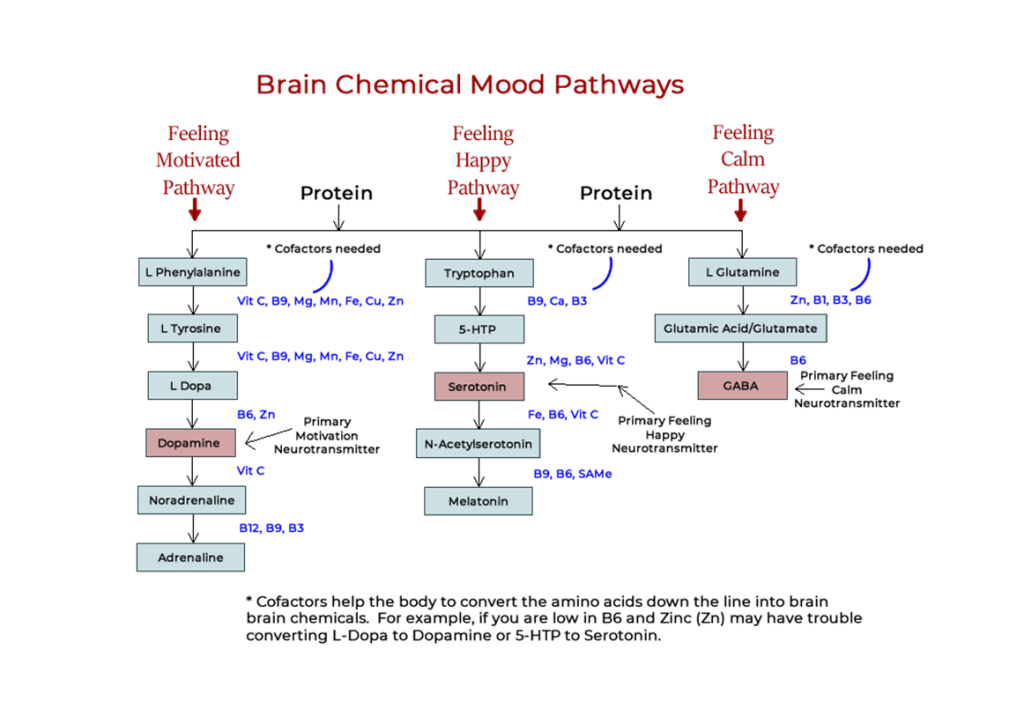
The differences between anxiety and mania can be seen in the illustration of the brain chemical pathways that can lead to these conditions.
The dopamine leg (the “Feeling Motivated Pathway”) in the illustration is ultimately responsible for mania when excessive oxidation occurs. Although this is not shown in the diagram, oxidized dopamine (aminochrome) and oxidized adrenaline (adrenochrome) in the brain can cause mania. We know less about aminochrome, but adrenochrome is for certain. So, the dopamine leg is responsible for mania when this pathway goes awry.
Low GABA is responsible for anxiety. The GABA leg (the “Feeling Calm Pathway”) is to the right in the illustration above, and it is a totally separate chemical pathway from the dopamine leg on the left. These are two very different brain chemicals.
These are also two different states of mind: anxiety and mania. And you can experience them both at the same time.
With mania, you have quick thoughts, very quick. In some ways, your thinking is so fast that you wonder why others cannot keep up with you. With mania, you don’t ever feel “bad.” (In fact, some people who have mania purposely avoid taking medication to keep the symptoms going because low levels of mania feel so good.) You are irritable and get upset with people easily, but you never really worry.
Mostly, this irritability comes from your being angry that others can’t keep up with you. Your thinking is so fast that you feel very smart. Sometimes, you may even become smarter because you are thinking so fast. However, the benefits of increased IQ can come at a steep cost. Loss of sleep, adrenal burnout, and other negative symptoms can sometimes occur with low levels of mania.
Then, the anger increases, and you eventually become very angry with others at the drop of a hat. As you progress into mania, you likely will start to lose touch with reality, and you may become even angrier more easily. This anger is not nervousness.
And then, as you reach even deeper into mania, you start to think strange thoughts, like you are Jesus Christ or spacemen are coming to get you. Or you may think agents are everywhere, and they are going to kill or recruit you, or you may have other strange thoughts.”
-> If you feel that you or someone you love is experiencing mania, see our Mania Wellness Questionnaire and Kit.
Coach Treeleaf says, “On the other hand, anxiety is nervousness. You aren’t angry or really irritable with anyone, though you may express some shortness with others because you are so nervous. You just can’t stop worrying. You can’t stop thinking that things are going to go wrong, even though you know they are going to be fine.
For example, at more advanced stages of anxiety, you may be watching TV and think you are going to crash in your car. This thought can be overwhelming even when you are not driving. You’re not angry; you are just full of worry. You never lose touch with reality as with mania.
Remember, sometimes you can have both at once, mania and anxiety. Mania is caused by oxidized adrenaline and possibly oxidized dopamine as well. Anxiety is caused by too low a level of GABA. These are two very different states of mind, and they are caused by imbalances in two different brain chemicals.”
For now, Coach wants you to concentrate on just your anxiety. “Here are a few questions to see if you have anxiety. If you feel you are having some or a lot of these symptoms, this may indicate that you are experiencing anxiety. Please, answer the following questionnaire.”
Anxiety Questions
Yes No
____ ____ 1. Are you nervous?
____ ____ 2. Are you jumpy and fearful?
____ ____ 3. Are you very easily surprised?
____ ____4. Do you worry too much about not having enough toilet paper (for example) when the next big storm comes? I’m not talking about rational planning here, but worry.
____ ____ 5. Do you feel drained very easily?
____ ____ 6. Do you sleep restlessly?
____ ____ 7. Do you have an inner fearfulness?
____ ____ 8. Do you have inner tension?
____ ____ 9. Are you easily stressed?
____ ____ 10. Do you tire easily and seem to have short endurance?
____ ____ 11. Women, do you have PMS symptoms?
____ ____ 12. Do you feel better when you skip breakfast?
____ ____ 13. Do you handle stress poorly?
____ ____ 14. Do you have poor dream recall?
____ ____ 15. Do you have a poor memory?
____ ____ 16. Do you have a history of panic attacks?
____ ____ 17. Do you have obsessive/compulsive behavior or feel driven?
____ ____ 18. Do you feel fatigue?
____ ____ 19. Do you feel restlessness?
____ ____ 20. Do you have low vitality?
____ ____ 21. Do you have trembling or shakiness?
____ ____ 22. Do you feel weakness?
____ ____ 23. Do you have a poor appetite or skip meals?
____ ____ 24. Are you easily irritated with others but not angry?
____ ____ 25. Does the world seem to center around you?
____ ____ 26. In the case of severe anxiety, you may even experience high blood pressure that worsens when tensions are higher. Do you experience this kind of high blood pressure? *
Coach says, “You don’t have to have every symptom above to have anxiety. You are simply looking for trends and severity. Our Anxiety Wellness Kit may be helpful if you recognize these trends in yourself. Try the Anxiety Wellness Kit as a first step for relief from your anxiety issues.”
-> Again, if you would like more help in overcoming your anxiety, see the book, Heal Your Brain and Mood Naturally: A Do-It-Yourself Guide, by Robert Brocato. Section 4 of this book should serve as a good place to start when looking into other areas of health that may be a root cause of your anxiety.
References
* Questions are loosely based on the book by Joan Mattews Larson, Depression Free Naturally. Many have been modified for our purposes here, and a few others have been added.

