

3. The Calcium Lie Continues: How Mineral Imbalance Is Quietly Hurting Women’s (and Men’s) Heart Health

This is the Third Article in the Heart Health series.
“I will praise You, for I am fearfully and wonderfully made; Marvelous are Your works, And that my soul knows very well”
(Psa 139:14, NKJV).
God wonderfully made us with all kinds of complex and intricate systems coming together marvelously and awesomely to allow our bodies to function and prosper. Everything is intertwined like many supercomputers networking and passing signals in a multifaceted and fantastic manner, all designed with purpose and meaning.
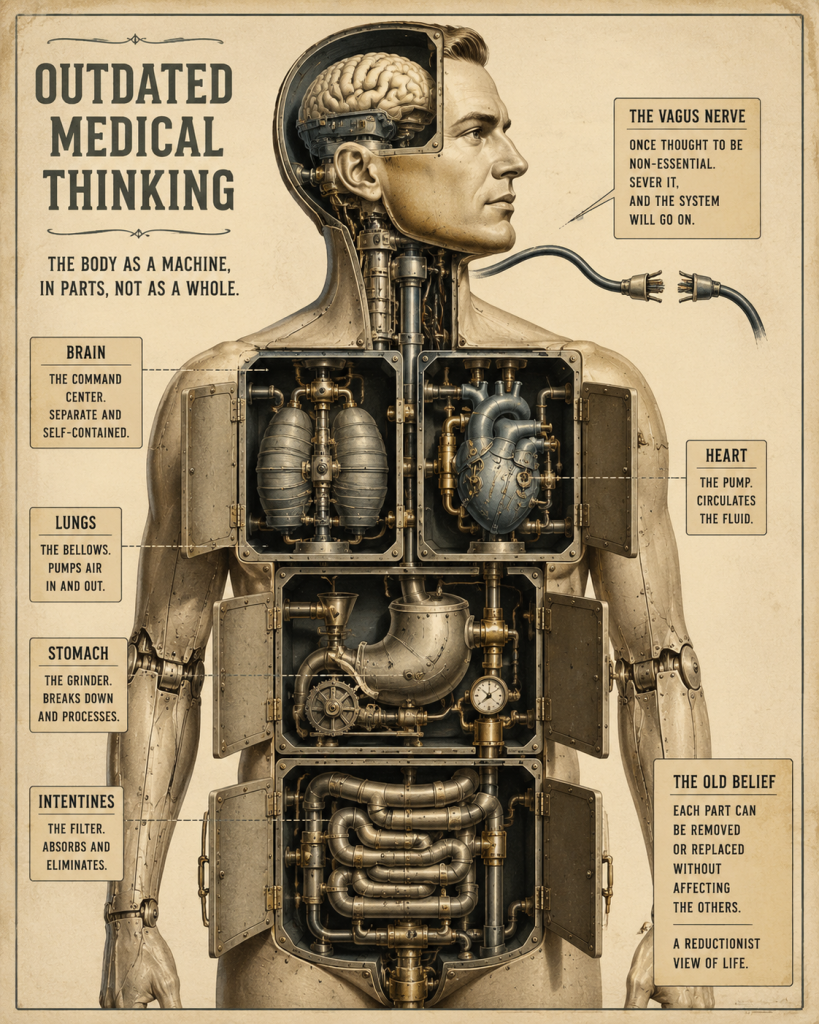
Scientists and doctors used to look at the human body and see a system of cogs or boxes. This would allow them to do things to the body, like remove your vagus nerve, called a vagotomy, if perhaps you were suffering symptoms of a peptic ulcer. They did not see all the uses and ways the body depends on this nerve. People who had a vagotomy would suffer from numerous complications because the vagus nerve helps carry nerve signals all over the body.
God’s salt has over “74 ionizing minerals” (2). Modern table salt has 2 or maybe 3. God created sea salt to provide all the minerals the human body needs in perfect proportion (2).
God created sea salt with all the minerals the human body needs in perfect proportion. In the late 19th century, man created modern table salt as an “advancement.” Man had used some processing before this time, but not like in the late 19th century. By 1925, the US was using almost exclusively sodium chloride as table salt. Now, all those numerous minerals that were in sea salt were reduced to just sodium and chloride. Yeah! An improvement! Right? And then later, manufacturers added some iodine – maybe. And let’s not forget all the added chemicals to make the “salt” free-flowing and easier to use.
God’s salt has over “74 ionizing minerals” (2). Modern table salt has 2 or maybe 3. God created sea salt to provide all the minerals the human body needs in perfect proportion (2).
The late 19th century brought us many “advancements” like white rice, white flour, and table salt. Did we really advance?
Introduction
If you’ve been following along in this book, you already know that vitamins alone don’t tell the whole story when it comes to bone and heart health. In this fourth installment, I look more closely at a true accounting of cellular calcium, and I reveal a little bit of why so many people—especially women—have been led toward a calcium-heavy supplement routine that may be doing more harm than good. This chapter makes the case that mineral balance, not simply more of any one mineral, is the real key to lasting health. Minerals need to be in balance and raised in most people.
Summary of What We Have Learned So Far in This Series
I have covered a lot of ground, and I want to be sure that you understand what I have said up to this point. After this, I will say even more.
Dr. Shute saw a significant improvement in 80 to 85 percent of his patients.
- Shute used just vitamins E and C.
- What if he had added vitamins K2 and D3?
- And what if he had added magnesium?
- What if he also looked at everyone’s cellular level of calcium and all their minerals?
What may have been his results if he had done all that?
Remember that arterial plaque usually consists of calcium deposits. And there is more I will explain to you. This is just the beginning in some ways. What do you suppose may be the results if you start a vitamin and supplement regimen that includes all of the above supplements taken at proper doses?
As a side note here, for proper dosing, it is my suggestion that you may want to seek the help of a nutrition specialist. I am giving general guidance, not specific advice.
More on Minerals and Women
In recent history, women in the US have made some negative advances. Nowadays, they are just as likely, or getting to be just as likely, as their male counterparts to have arteriosclerosis and atherosclerosis and all the negative effects this creates, including heart attacks and other negative consequences. Yes, women in the US have made gains.
Why do you suppose women have made such gains? The answer isn’t really that hard. In all likelihood, it involves the following. Middle-aged women in the US are the most likely to listen to advertising online and buy supplements because of the advice they hear.
Some say that women account for 85% of all consumer purchases and that middle-aged and older women are more likely to purchase online. Some claim that they make 80% of all healthcare purchases (1). Even if these numbers are off, there is no doubt that they are way more likely to buy supplements and related products than men and do so online.
Doctors are also saying the same thing to women, even though doctors are not trained in nutrition. Commercials on TV, the internet, and all over the place, they all say the same thing. The message is loud and clear.
“Got milk?”
Take calcium for strong bones. The message may or may not include taking vitamin D3 as well.
The result of all that messaging is that middle-aged and slightly older women are very likely to buy and take calcium, thinking they are improving their health.
In fact, most likely, they are hurting their health. I know there may be other factors involved, such as diet and more, but taking too much calcium is a huge part of the equation.
- Middle-aged women are more likely to buy healthcare products than men.
- Women are barraged with messaging that says to take more calcium.
- Taking calcium in excess is likely to help bring on atherosclerosis.
- Women have been increasingly catching up with men in having this condition in recent history.
Again, I certainly acknowledge that there are other factors involved, but the facts I have just listed play a huge role. Listen to this story.
Dr. Sarah Mitchell’s Story
Dr. Thompson tells a story of a woman he treated for excess calcium. She happened to be a doctor who thought she was doing everything right for her health, and yet had no energy and had recently had a heart attack.
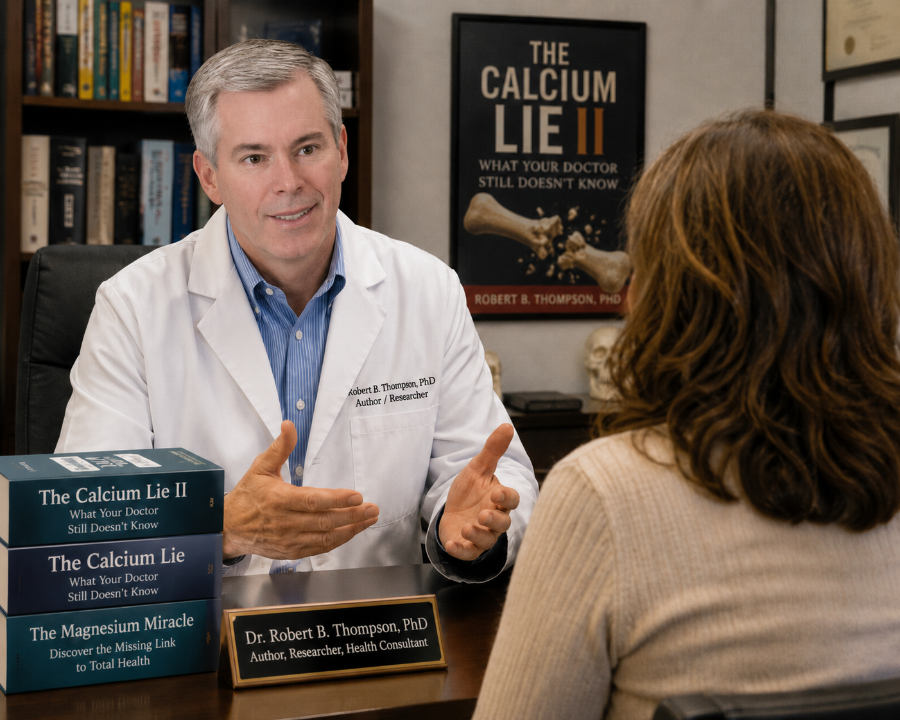
Dr. Sarah Mitchell had been following all the advice she was given. The ads, her doctors, and almost everyone told her to take calcium, take vitamin D, avoid salt, and drink plenty of water. So, she did for years. Her DEXA scan came back good; her tested cholesterol levels were fine, and everything was great. And then, at age 58, she had a heart attack that almost killed her.
Six months later, she learned about testing her minerals with an HTMA test, and she finally understood. She saw her results. She was 340% above normal in calcium and low in potassium as well, at around 12% (2).
She said, “I wasn’t preventing heart disease, I was creating it, one calcium pill at a time” (2).
Today, Sarah is off all cardiac medications and has reversed her condition by getting her calcium levels down and her minerals more in balance. It took about a year, but she did it. As a doctor, she knew how to monitor her progress. Also, while increasing her potassium levels, over time, she realized a gain in energy and feels younger and stronger (2).
The Truth About Minerals
The truth is that almost everyone is too low in minerals or out of balance in minerals or both. Between the two, often being out of balance is worse than being too low. Dr. Robert Thompson reported, “In more than 12 years of analyzing mineral statuses and treating nearly 2,000 patients, I have seen only one patient who had no deficiencies at all, and his imbalances were minimal. This is a rare patient. We all need to know our tissue mineral levels and ratios to meaningfully improve our health” (3).
Virtually everyone is low in minerals and out of balance. If you are out of balance in many key ratios, many health problems can occur, including depression, uncontrollable anger, heart health issues, weak and brittle bones, poor memory, and many more (3,4). Again, being out of balance is a greater problem in most cases than being too low.

“Think of it like this: potassium and water create flexible, hydrated proteins that work like well-oiled machinery. Calcium excess creates stiff, dehydrated proteins that work like rusted gears grinding against each other.
These dysfunctional ‘prion’ proteins are found in every major disease: cancer, Alzheimer’s, heart disease, and Parkinson’s. They are not the cause of aging – they’re the result of calcium excess combined with potassium deficiency” (2).
And, if you are low in minerals, you will also not have optimal health, as everything will begin to wind to a screeching halt. Dr. Thomson said this, “I can say without reservation that more than 95 percent of us are mineral deficient…” (3).
There is no evidence to support the idea that older people don’t need the same mineral levels as younger people. They do. And, again, almost all of us are too low. We see lower levels of minerals in older people because they have lost them over time due to poor diet and other factors, and then we say, “Hey, it’s a normal part of aging.” In actuality, it is not normal, and you will age just fine if you maintain all your minerals. If you lose them, you will suffer needlessly and likely die younger than you would have.
Your bones are not just made of calcium. “Bones contain at least 12 essential minerals and traces of 78 total minerals” (2). If you give your bones an excess of calcium, you tend to make them more brittle, and they break more easily.
Calcium is what they put in concrete to make it harder, but bones are not steel-reinforced concrete. Bones are living tissue. If you treat them as if they are concrete, then you wind up with brittle bones, not stronger bones.
Let me ask you a question as an analogy. Which is easier to break? A green stick or an old dried stick? The old dried stick is easier to break. Your bones need all the ingredients God created in them to maintain their “green color.” If they turn “brown,” it is because all the minerals are missing, or you just added hardener. One mineral, calcium, that makes bones harder, is not going to make your bones green. In fact, it will just make them easier to break because it just makes them more brittle.
The point is this: we all need all of our minerals, not just a few or one mineral. You need all of them, and you likely need to raise them all and keep them in balance. Additionally, around 90 to 95% of people in the US have been supplementing with predominantly calcium, and the result is out-of-balance mineral levels.
All that excess calcium is leading to hardening of the arteries and an increased risk of negative symptoms: heart attacks, strokes, kidney disease, and more.
Sea Salt and Water
God created sea salt with all the minerals the human body needs in perfect proportion (2). Man created table salt and took everything out of it except sodium and chloride. Then, he added some iodine in some cases. And as I said earlier, man also added nasty chemicals to make the salt free-flowing and easier to pour.
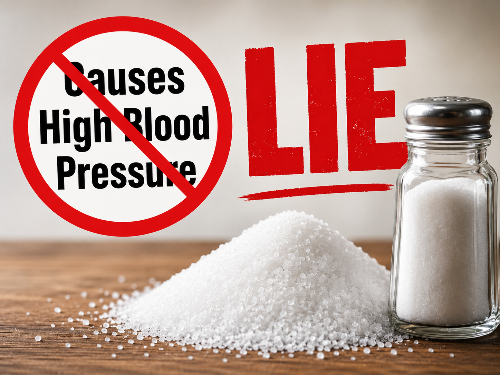
There is so much misinformation about salt that it is hard to know where to begin. I will just state it briefly. There is little real evidence to support the notion that lowering salt helps the heart with blood pressure or in any other way. The truth is that few people are known to have salt allergies, and if these people take a salt tablet, they may temporarily see an increase in blood pressure. This is not the same as a judicious use of actual sea salt. Salt tablets are made of just sodium chloride and are not complete minerals.
Most of the surveys, both in the US and around the world, support the idea that people who eat more salt have a lower risk of heart disease. Lowering salt almost always increases the incidence of heart disease and death. To my knowledge, other than testing sodium chloride salt tablets for temporary increases of blood pressure in some people, there is no evidence to say sea salt raises blood pressure at all. People just claim it does.
Around the world, a greater intake of sea salt equates to longer and healthier lives.
“So, what’s the evidence for these mineral truths?
… the Tibetans in China’s northeast plateau, the Hunzas in Pakistan, the Titicacans of Peru’s Andes Mountains, the Vilacamba of the Ecuadorean Andes, and the Russian Georgians and their sister cultures, the Abkhazians, Azerbaijanis and the Armenians of the Caucasus mountains as far as northern Turkey. Centenarians, those who live more than 100 years, are quite common in these cultures.
The large amount of sea salt consumption (up to 20 grams per day in some cases) and longevity in these simple cultures is a strong indicator of the value of minerals from natural salts, either from the seas or from the salt mines that mark the remains of ancient seas. It’s something our society should reconsider” (3).
A good way to help your mineral levels is to eat a little sea salt with your water every day. Since sea salt has all of the minerals the human body needs in perfect proportion, when you eat some every day, you not only tend to raise your mineral levels, but you also tend to even out anything that is out of proportion.
If you consume high levels of just water, you tend to force more minerals out of the body. This is especially true for electrolytes. If you add enough sea salt to your water, this does not happen.
If you find you are seriously out of balance on an HTMA test, you may be better off taking other corrective action. For example, if you find you are seriously low in potassium, then supplementing with some potassium may help more than just taking sea salt alone.
HTMA testing
As you look to be tested for minerals, remember this. Blood tests are not accurate. A normal doctor’s office blood test will assess only about 6% of your actual mineral levels, while an HTMA test is more like 94% accurate (2). One good place to get an HTMA test is Trace Elements Inc (TEI). Another place that may help is Doctor’s Data, as described below.
So, the woman doctor I talked about earlier, Sarah Mitchel, would likely have never known she was 340% too high in calcium and too low (only 12%) in potassium if she had only gone by the standard tests. She would likely still be getting more and more ill. Don’t rely on the standard doctor’s office visit tests.
Final Words
If you want strong bones, a healthy heart, and greatly improved overall wellness, get an HTMA test done, raise all your minerals, and try to get them back in balance.
The HTMA test I recommend is the one put out by Trace Elements Inc. It will give you way better results and cover more minerals (and unwanted heavy metals) than any test your doctor will likely order. It will also come with a list of doctors’ recommendations that you may find useful.
One thing missing from this test is your iodine levels, a special mineral called a halide. It is beyond the scope of this article to discuss this very much, but suffice it to say, your iodine levels are very important as well. An HTMA test may not give you accurate results on your iodine levels. Blood tests from your doctor aren’t helpful either. You need to supplement with iodine for about 3 to 6 months before any meaningful test can be done. And then you will be required to pee in a bottle. You can order such tests through Doctor’s Data.
Your iodine and selenium levels should be in balance as well. How to do this is beyond the scope of this article.
Another detail that I am not going to cover very much is that your pH level has a lot to do with your bone health, as well as your overall health. Most of us are very acidic, and taking sodium bicarbonate (baking soda) tends to raise our pH and make us more alkaline. When you take baking soda, you raise your pH, and you improve your overall health, bone health, and heart health.
Sodium bicarbonate should be taken at ¼ tsp per day for two weeks, and then stop for two weeks, and then start again. Buy some saliva test strips. Don’t buy the urine test strips. The saliva test strips provide a more accurate representation of your blood pH. Test often, and when your test strip shows you are at a pH level of 7.4, you can stop. Check your pH levels from time to time after this.
Bicarbonate is part of a special group of minerals known as electrolytes. These tend to leave the body faster than other minerals. There are seven electrolytes in the body: sodium, potassium, calcium, magnesium, chloride, bicarbonate, and phosphate. Because they leave the body faster, it is important to supplement with them slightly more than with other minerals.
And remember, drinking plain water tends to force out all minerals, but especially your electrolytes. Adding some sea salt or other electrolyte powder on occasion helps to reverse this.
As a side note, another way to raise your mineral levels is through whole food fruits and vegetables. However, this can take a long time. And the fruits need to be tree-ripened to really be of any value. This can be a difficult process.
Conclusion
Calcium taken without all of the other minerals that the body needs doesn’t strengthen the body—it tends to stiffen it, in the same way calcium stiffens concrete.
Key takeaways:
- Balance matters more than any single mineral. Being out of ratio—too much calcium relative to potassium and magnesium, for example—can be more damaging than simply being low in a nutrient.
- Calcium-heavy messaging has consequences. Decades of “take your calcium” advertising, often aimed at women, may be contributing to the very arterial and bone problems it claims to prevent.
- Standard blood tests don’t tell the full story. They capture only a small fraction of your actual mineral status; more comprehensive testing (like HTMA) offers a fuller picture.
- Whole-food minerals like sea salt beat isolated ones. Sea salt, used judiciously, supplies a broad spectrum of minerals needed by the body in a natural proportion—something refined table salt and single-mineral supplements can’t replicate.
Next in this series, I will look at diets and the food you eat. You likely could do better. People tend to be misinformed about diets and food in general. For example, as a tickler, if your regular diet is not high enough in fat, you could have trouble holding onto all your fat-soluble vitamins, including vitamins E, K2, and D3.
References
- The Purchasing Power of Women: Statistics. Girlpower Marketing [Internet]. [cited 2026 Jun 25]. Available from: https://girlpowermarketing.com/statistics-purchasing-power-women/
- Thompson, Robert. Mineral Medicine. Dr. Robert Thompson, MD; 2025.
- Thompson, Robert; Barnes, Kathleen. The Calcium Lie II: What Your Doctor Still Doesn’t Know. Take Charge Books. Kindle Edition.
- Walsh WJ. 3 Nutrient Power: Heal Your Biochemistry and Heal Your Brain. New York, NY: Skyhorse Publishing; 2014. 1 p.